← Back to references Case study · Product development

Photogrammetry 3D scanner for footwear

A machine that photographs a shoe from every angle – including the sole – for 3D reconstruction. From the lessons of the first prototype to a concept design with three automation levels, data sheets, cost estimate and a fixed-price quotation.

Client
3D / AR technology company, EU
Scope
Concept design, variants, cost estimate, quotation
Tools
SolidWorks · animations · calculations
Status
Concept complete, prototype in preparation
The challenge

The shoe must not move a millimetre

Gaussian-splatting reconstruction needs a complete, repeatable set of photographs from all sides – top, sides and underneath the sole. The first prototype showed where the problems were: the object moved during the scan, holders covered parts of the shoe, and imaging conditions depended on the room.

The task: hold the shoe so that nothing is hidden and no marks are left, move the cameras instead of the object, and make every position repeatable.
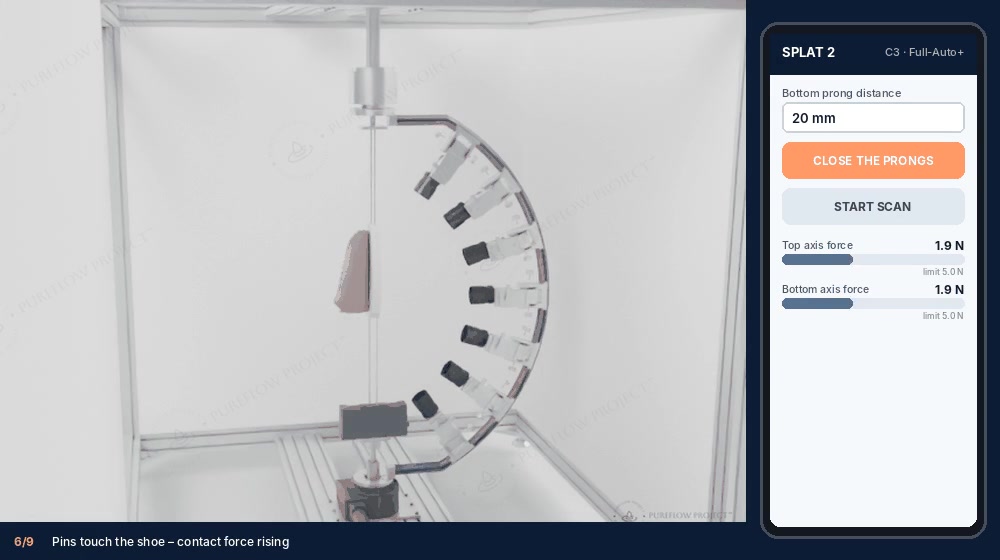
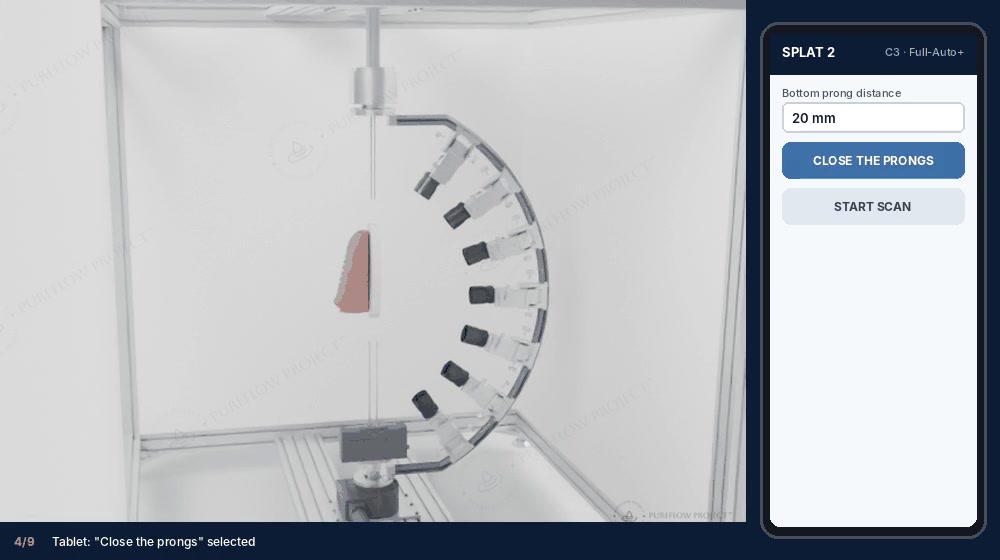
Pins close onto the shoe, contact force shown on the tablet
Pins approach the shoe; contact force is shown live on the tablet.
The solution

The object stands still, the cameras move

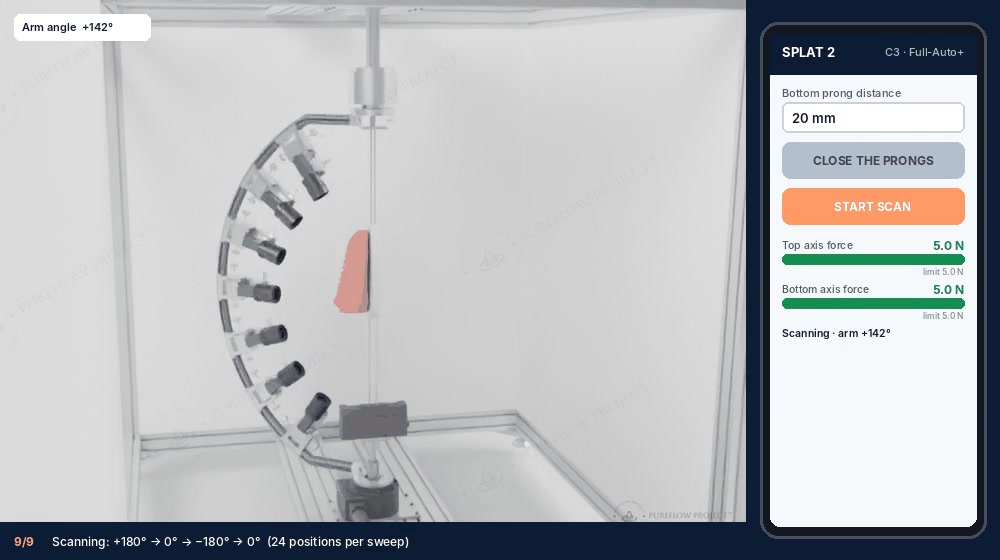
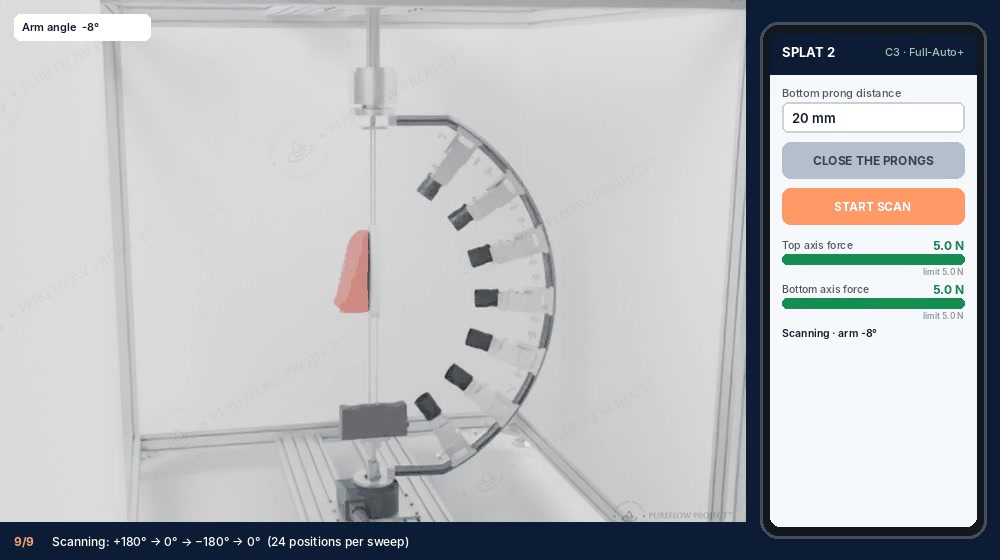
A closed light chamber with an arm carrying seven cameras around a shoe held on four thin pins. Every key decision was made to remove a risk seen on the prototype.

Operating cycle animation: pin spacing → closing the pins → scan ±180°.
Three automation levels

Start simple, upgrade without waste

Same chamber, same arm, same cameras – only the lower holder differs. The client can start with the simplest variant and upgrade once the need is proven.

C1 Semi-Auto – motorised upper axis, pin spacing set by hand.
C2 Full-Auto – both axes approach automatically with force control.
C3 Full-Auto+ – an electric gripper sets the pin spacing entered on the tablet.

Key figures

Design targets

7cameras on an arc of −48° … +48°
5 Ncontact force, adjustable 3–10 N
±0,5°target arm repeatability
5 → 2 mintarget cycle per shoe, C1 → C3
Honest about targets. The machine is a one-off, so all performance values are design targets from the 3D model, calculations and component catalogues. That is why measurable acceptance criteria (holding force, marks on the shoe, repeatability, 50 consecutive cycles, lighting uniformity, safety functions) were agreed up front and are verified at the factory acceptance test.
What we delivered

Everything needed to decide

The client got a complete picture before talking terms: what the machine does, how each variant differs, what it costs and what “it works” means.

  • 3D model of all three variants (SolidWorks, STEP)
  • Data sheets per variant with acceptance criteria
  • Cost estimate by subsystem with transparent material prices
  • Fixed-price quotation by packages, schedule and terms
  • Workflow animations for each variant

Developing a device or a machine?

Send a sketch, a photo or a description – we will reply with a scope and a fixed price.

Send an enquiry